
Bhagavad Gita
Chapter 12: Bhakti Yoga
The Yoga of Devotion
Source: Bhagavad-gītā As It Is by A.C. Bhaktivedanta Swami Prabhupada
vedabase.io
Sanskrit Verses
Text 1
arjuna uvāca evaṁ satata-yuktā ye bhaktās tvāṁ paryupāsate ye cāpy akṣaram avyaktaṁ teṣāṁ ke yoga-vittamāḥ
Text 2
śrī-bhagavān uvāca mayy āveśya mano ye māṁ nitya-yuktā upāsate śraddhayā parayopetās te me yukta-tamā matāḥ
Texts 3-4
ye tv akṣaram anirdeśyam avyaktaṁ paryupāsate sarvatra-gam acintyaṁ ca kūṭa-stham acalaṁ dhruvam sanniyamyendriya-grāmaṁ sarvatra sama-buddhayaḥ te prāpnuvanti mām eva sarva-bhūta-hite ratāḥ
Text 5
kleśo 'dhika-taras teṣām avyaktāsakta-cetasām avyaktā hi gatir duḥkhaṁ dehavadbhir avāpyate
Texts 6-7
ye tu sarvāṇi karmāṇi mayi sannyasya mat-parāḥ ananyenaiva yogena māṁ dhyāyanta upāsate teṣām ahaṁ samuddhartā mṛtyu-saṁsāra-sāgarāt bhavāmi na cirāt pārtha mayy āveśita-cetasām
Text 8
mayy eva mana ādhatsva mayi buddhiṁ niveśaya nivasiṣyasi mayy eva ata ūrdhvaṁ na saṁśayaḥ
Text 9
atha cittaṁ samādhātuṁ na śaknoṣi mayi sthiram abhyāsa-yogena tato mām icchāptuṁ dhanañ-jaya
Text 10
abhyāse 'py asamartho 'si mat-karma-paramo bhava mad-artham api karmāṇi kurvan siddhim avāpsyasi
Text 11
athaitad apy aśakto 'si kartuṁ mad-yogam āśritaḥ sarva-karma-phala-tyāgaṁ tataḥ kuru yatātmavān
Text 12
śreyo hi jñānam abhyāsāt jñānāt dhyānaṁ viśiṣyate dhyānāt karma-phala-tyāgas tyāgāc chāntir anantaram
Texts 13-14
adveṣṭā sarva-bhūtānāṁ maitraḥ karuṇa eva ca nirmamo nirahaṅkāraḥ sama-duḥkha-sukhaḥ kṣamī santuṣṭaḥ satataṁ yogī yatātmā dṛḍha-niścayaḥ mayy arpita-mano-buddhir yo mad-bhaktaḥ sa me priyaḥ
Text 15
yasmān nodvijate loko lokān nodvijate ca yaḥ harṣāmarṣa-bhayodvegair mukto yaḥ sa ca me priyaḥ
Text 16
anapekṣaḥ śucir dakṣa udāsīno gata-vyathaḥ sarvārambha-parityāgī yo mad-bhaktaḥ sa me priyaḥ
Text 17
yo na hṛṣyati na dveṣṭi na śocati na kāṅkṣati śubhāśubha-parityāgī bhaktimān yaḥ sa me priyaḥ
Texts 18-19
samaḥ śatrau ca mitre ca tathā mānāpamānayoḥ śītoṣṇa-sukha-duḥkheṣu samaḥ saṅga-vivarjitaḥ tulya-nindā-stutir maunī santuṣṭo yena kenacit aniketaḥ sthira-matir bhaktimān me priyo naraḥ
Text 20
ye tu dharmyāmṛtam idaṁ yathoktaṁ paryupāsate śraddadhānā mat-paramā bhaktās te 'tīva me priyāḥ
English Translation
Text 1
Arjuna inquired: Which are considered to be more perfect, those who are always properly engaged in Your devotional service or those who worship the impersonal Brahman, the unmanifested?
Text 2
The Supreme Personality of Godhead said: Those who fix their minds on My personal form and are always engaged in worshiping Me with great and transcendental faith are considered by Me to be most perfect.
Texts 3-4
But those who fully worship the unmanifested, that which lies beyond the perception of the senses, the all-pervading, inconceivable, unchanging, fixed and immovable – the impersonal conception of the Absolute Truth – by controlling the various senses and being equally disposed to everyone, such persons, engaged in the welfare of all, at last achieve Me.
Text 5
For those whose minds are attached to the unmanifested, impersonal feature of the Supreme, advancement is very troublesome. To make progress in that discipline is always difficult for those who are embodied.
Texts 6-7
But those who worship Me, giving up all their activities unto Me and being devoted to Me without deviation, engaged in devotional service and always meditating upon Me, having fixed their minds upon Me, O son of Pṛthā – for them I am the swift deliverer from the ocean of birth and death.
Text 8
Just fix your mind upon Me, the Supreme Personality of Godhead, and engage all your intelligence in Me. Thus you will live in Me always, without a doubt.
Text 9
My dear Arjuna, O winner of wealth, if you cannot fix your mind upon Me without deviation, then follow the regulative principles of bhakti-yoga. In this way develop a desire to attain Me.
Text 10
If you cannot practice the regulations of bhakti-yoga, then just try to work for Me, because by working for Me you will come to the perfect stage.
Text 11
If, however, you are unable to work in this consciousness of Me, then try to act giving up all results of your work and try to be self-situated.
Text 12
If you cannot take to this practice, then engage yourself in the cultivation of knowledge. Better than knowledge, however, is meditation, and better than meditation is renunciation of the fruits of action, for by such renunciation one can attain peace of mind.
Texts 13-14
One who is not envious but is a kind friend to all living entities, who does not think himself a proprietor and is free from false ego, who is equal in both happiness and distress, who is tolerant, always satisfied, self-controlled, and engaged in devotional service with determination, his mind and intelligence fixed on Me – such a devotee of Mine is very dear to Me.
Text 15
He by whom no one is put into difficulty and who is not disturbed by anyone, who is equipoised in happiness and distress, fear and anxiety, is very dear to Me.
Text 16
My devotee who is not dependent on the ordinary course of activities, who is pure, expert, without cares, free from all pains, and not striving for some result, is very dear to Me.
Text 17
One who neither rejoices nor grieves, who neither laments nor desires, and who renounces both auspicious and inauspicious things – such a devotee is very dear to Me.
Texts 18-19
One who is equal to friends and enemies, who is equipoised in honor and dishonor, heat and cold, happiness and distress, fame and infamy, who is always free from contaminating association, always silent and satisfied with anything, who doesn't care for any residence, who is fixed in knowledge and who is engaged in devotional service – such a person is very dear to Me.
Text 20
Those who follow this imperishable path of devotional service and who completely engage themselves with faith, making Me the supreme goal, are very, very dear to Me.
Translations and verse texts from Bhagavad-gītā As It Is by His Divine Grace A.C. Bhaktivedanta Swami Prabhupada.
© Bhaktivedanta Book Trust. For detailed purports and commentary, please visit vedabase.io
Spiritual Significance
Scriptural Source & Tradition
Commentary from the Acharyas
When to Sing / Chant
Benefits for the Devotee
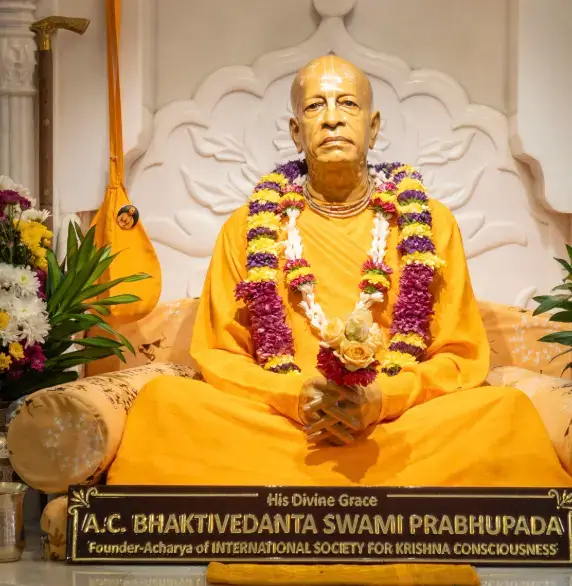
Gratitude to His Divine Grace A.C. Bhaktivedanta Swami Srila Prabhupada
We offer our humble obeisances at the lotus feet of our founder-acharya, His Divine Grace A.C. Bhaktivedanta Swami Srila Prabhupada, without whose causeless mercy the priceless prayers, bhajans and sacred literature of the Gaudiya Vaishnava tradition would have remained inaccessible to most of the world. By his herculean preaching efforts, his unparalleled translations and his founding of the International Society for Krishna Consciousness (ISKCON), the holy names, pastimes and instructions of Sri Sri Radha-Krishna and Sri Chaitanya Mahaprabhu are today chanted in every town and village.
nama om vishnu-padaya krishna-preshthaya bhu-tale
srimate bhaktivedanta-svamin iti namine
namas te sarasvate deve gaura-vani-pracharine
nirvishesha-shunyavadi-pashchatya-desha-tarine
All glories to Srila Prabhupada. All glories to the Vaishnava acharyas in the disciplic succession.